Publications
Browse the full catalog. Sign in to access your subscription or purchase individual titles.

AFS Health & Safety Guides, 5th Edition
The AFS Safety & Health Committee, under the guidance of the Environmental, Health and Safety Division, assists foundries in meeting their obligation to provide a workplace free of recognized health and safety hazards. This is accomplished in part through training, providing guidance documents, and reviewing/conducting research on new and/or existing processes to improve foundry employee health and safety protection. Additionally, on the national level, the AFS Safety & Health Committee represents the metalcasting industry in regulatory proceedings and in the development of health and safety standards. This fifth revision (2025) of the “AFS Health and Safety Guides” was completed under the direction and guidance of the AFS Safety & Health Committee to provide technical updates to 17 of the 68 individual guides due to new Federal OSHA regulations and improved information on hazards and best management practices. Seventeen guides (Beryllium, Hexavalent Chromium, Chromium-Metallic and Trivalent, Decomposition Products, Combustible Dust, Ergonomics, Hazardous Communication, Heat Stress, Iron Oxide, Management Systems, Manganese, Medical Surveillance, OSHA Inspections, Silica/Respirable Crystalline, Sulfur Dioxide, Ventilation Control, and Welding & Cutting) were revised to reflect the most up-to-date regulations. A new guide, Safety and Health Management Systems for Foundries, has been added to help foundries determine, evaluate and control potential safety and health hazards in the workplace. The updated information in this fifth edition is necessary to determine, evaluate and control potential health and physical hazards in metalcasting facilities. This publication was created and written specifically for metalcasting industry personnel, occupational health & safety professionals, personnel responsible for regulatory compliance, and academia professionals.
AFS Reduced Pressure Test
This standard prepared by the AFS Aluminum & Light Metals Division, documents critical details and best practice procedure for reduced pressure testing (RPT) of aluminum melts for evaluating insoluble gas content and other impurities. The standard addresses both atmospheric (true) and relative pressure testing methodologies and helps identify to resolve potential and observed missteps in device maintenance, pressure limits, system checks, timing and other items to ensure an optimized and repeatable evaluation. Casting users, students, process engineers, foundry metallurgists, QA lab technicians and other foundry staff and management will benefit from this standard.
Purchase →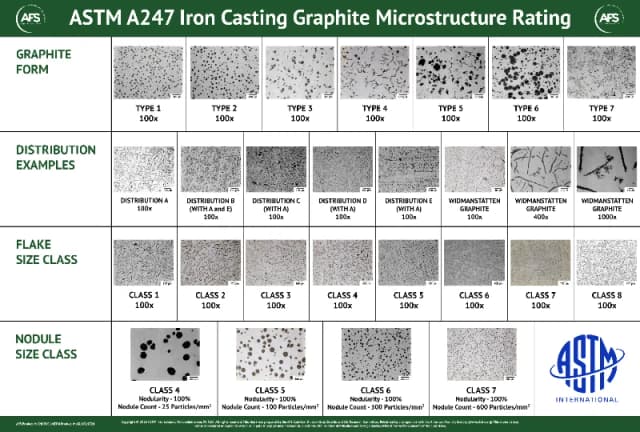
ASTM A247 Iron Casting Graphite Microstructure Rating Chart
This rating chart supplements ASTM Specification A247, and is used to determine graphite form, size and distribution, for both gray and ductile iron. You will find this chart a valuable addition to the metallurgy lab to meet the requirements of ASTM A247.
Purchase →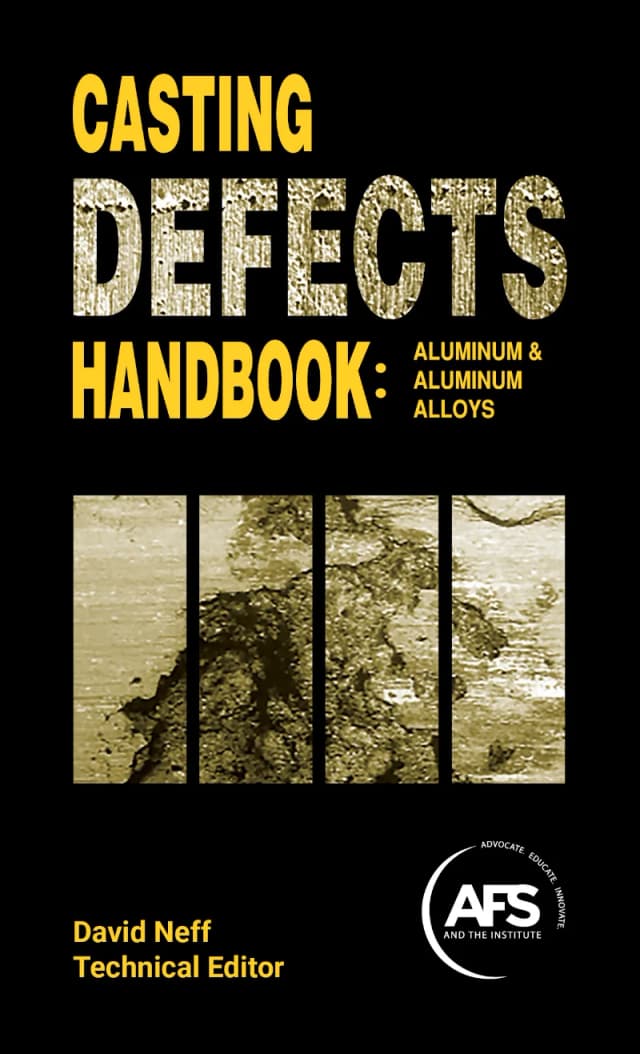
Casting Defects Handbook: Aluminum & Aluminum Alloys
Many of the common types of casting defects encountered in the production of aluminum alloy castings are presented. These defects are categorized by production method: sand-casting, permanent mold, high pressure diecasting, low pressure, investment, plaster and lost foam, with possible causes and, in some cases, prevention techniques listed. The material is presented in an easy-to-review format suitable for foundry floor operators, as well as process engineers, metallurgists and quality control personnel. The book provides a comprehensive visual atlas of the more common casting defects encountered by aluminum foundry personnel and provides a tool for quick identification. It can also be used to address possible causes and to establish corrective actions.
Purchase →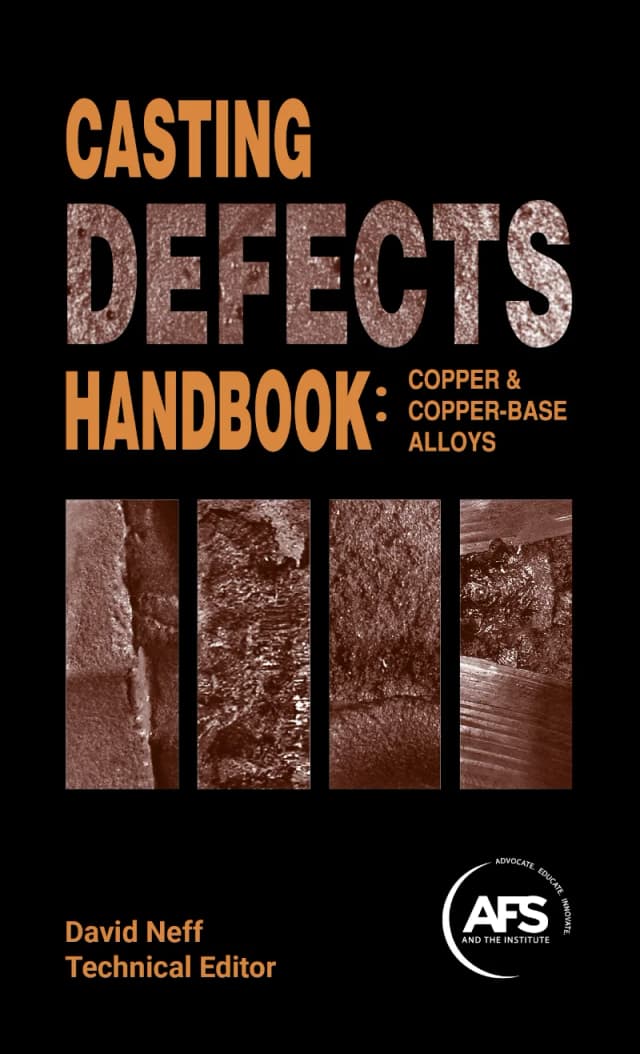
Casting Defects Handbook: Copper & Copper-Base Alloys
Casting Defects Handbook: Copper & Copper-Base Alloys, many of the common types of casting defects encountered in the production of copper base alloy castings in both sand and permanent mold processes are presented. These defects are categorized by type with possible causes and, in some cases, prevention techniques. The material is presented in an easy-to-review format suitable for foundry floor operators, as well as process engineers, metallurgists and quality control personnel. The book provides a comprehensive visual atlas of the more common casting defects encountered by copper base foundry personnel, and provides a tool for quick identification. It can also be used to address possible causes and to establish corrective actions.
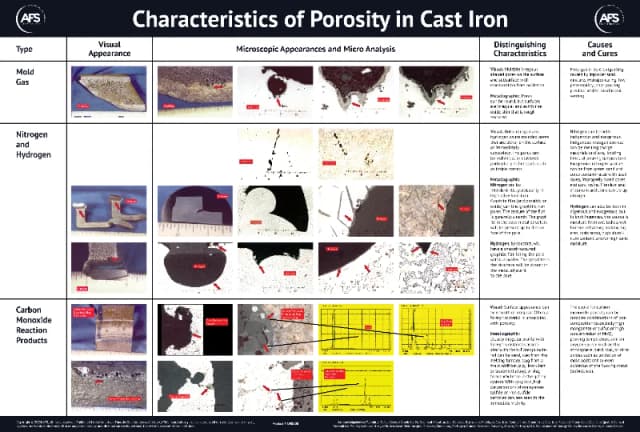
Characteristics of Porosity in Cast Iron Chart
This chart shows the type of gas porosity (mold gas, nitrogen and hydrogen, carbon monoxide reaction products), its microscopic appearance and microanalysis, what its distinguishing characteristics are, and its causes and cures.
Purchase →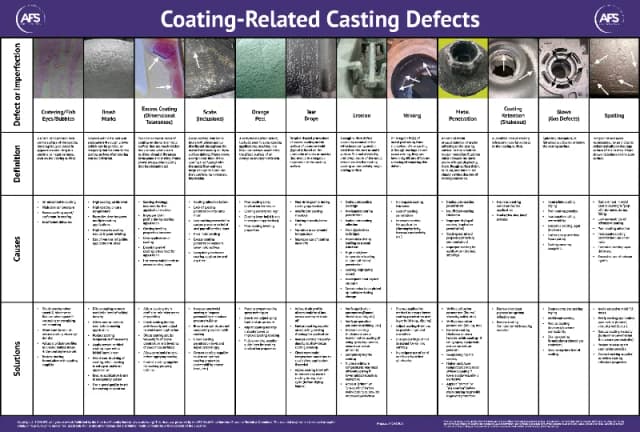
Coatings-Related Casting Defects Chart
This full color chart is intended to aid in classifying coating defects in metal castings, suggest potential causes and offer various solutions. It will prove to be an invaluable resource in helping to produce consistent high-quality castings. The chart is organized with 12 full color photos of the coating defect or imperfection, complete definition, a number of possible causes, and potential solutions. Specific defects or imperfections covered are: Cratering/Fish Eyes/Bubbles, Brush Mark, Excess Coating, Scabs/Inclusions, Orange Peel, Tear Drops, Erosion, Veining, Metal Penetration, Coating Retention, Blows (Gas Defects), and Spalling.
Purchase →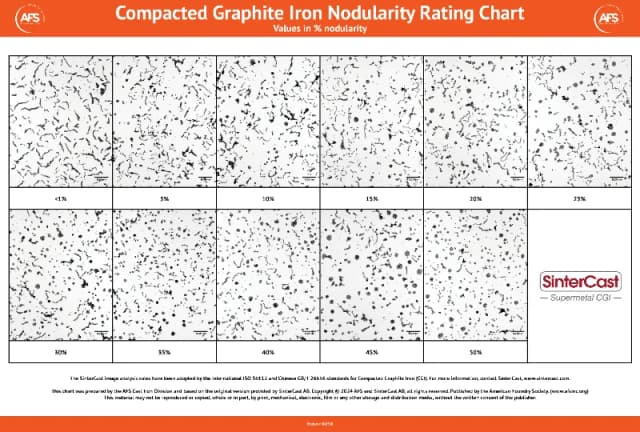
Compacted Graphite Iron Nodularity Rating Chart
Using 11 photographs, this quick reference chart shows degrees of modification at two magnifications along with a complete range of grain sizes. Both have tables that describe the type of modified structure and the actual grain size as measured by various techniques.
Purchase →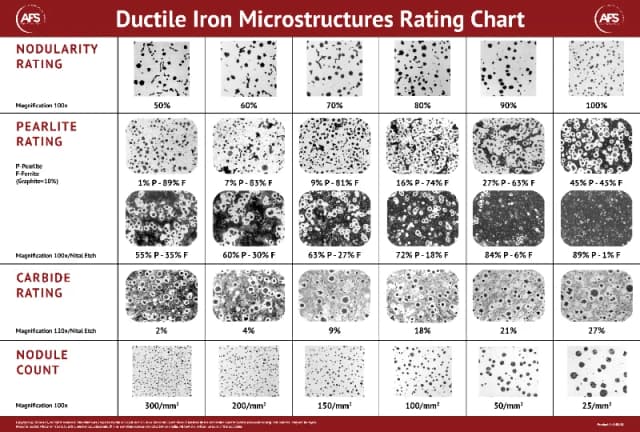
Ductile Iron Microstructures Rating Chart
This useful wall chart allows metallographers to make quick comparisons so that they can determine ratings of percent nodularity, pearlite, and carbide, as well as a nodule count for ductile iron.
Purchase →
Ferrous Scrap Guide
Based on the Iron Casting Research Institute's (ICRI) Ferrous Scrap Materials Manual, this book contains the basic data sheet style, now with larger, sharper photographs of various types of scrap. Chapters in the book contain information on scrap preparation, specification development and supplier development. The scrap data sheets have their own table of contents, with ten cast iron grades and 18 steel grades. The appendix contains specifications from the Institute of Scrap Recycling Industries, Inc., and the Association of American Railroads. The Rogues Gallery section has its own table of contents and contains examples of 19 types of unwanted scrap.
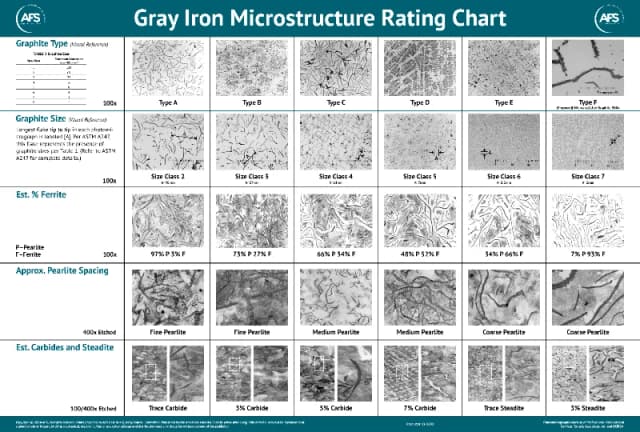
Gray Iron Microstructure Rating Chart
This wall chart provides metallographers and other lab personnel a quick and easy way to compare in-house microstructures with standard gray iron microstructures. Graphite type and size, estimated percent ferrite, pearlite spacing, estimated carbides and steadite content can all be quickly referenced with this chart.
Purchase →
Green Sand Additives, 3rd Edition
Green Sand Additives, 3rd Edition, is a guide to proper additive use in green sand mixtures. Included are the effects of proper and improper use of additives, listing indicative tests and typical observations. Most of the individual ingredients incorporated into pre-blended mixtures are addressed, as well as carbons, cellulose, cereals and starches, chemicals, clays, refractories and water.
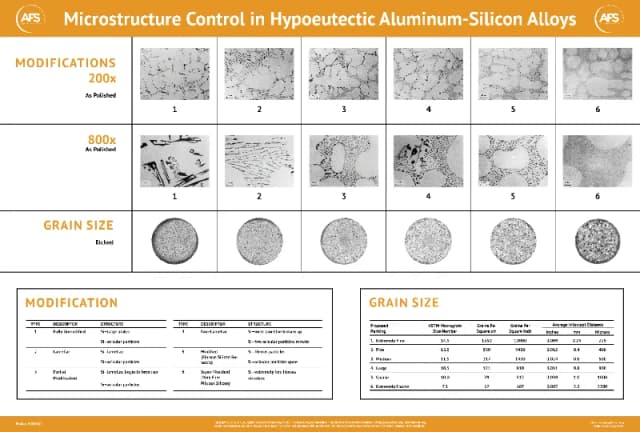
Microstructure Control in Hypoeutectic Al-Si Alloys Chart
Using 18 photographs, this quick reference chart shows degrees of modification at two magnifications along with a complete range of grain sizes. Both have tables that describe the type of modified structure and the actual grain size as measured by various techniques.
Purchase →
Process Control for Engineers
The newest book from AFS, "Process Control for Engineers," (PCE) debuted at the 2023 AFS Metalcasting Congress. PCE was written to provide engineers engaged in improvement, an essential orientation to their job through a greater understanding of process control. Trusted for decades as a training tool for quality and production engineers in major foundries, this content has been vetted and modified and is now available as a book that captures the philosophy and structure of quality improvement as applied to the practical task of the engineer on the shop floor. All those engaged in process improvement are looking for stable and predictable outputs?trouble-free days where the focus can be on proactive performance enhancements, not reactive corrections. But what does that look like from a practical perspective? How is process control strengthened to the point that smooth operations result? While there is no canned formula for success, this new book provides a detailed series of aspects to be considered and controlled, with very practical suggestions for appropriate control mechanisms to stabilize process factors of influence. Process Control for Engineers can be read with benefit by experienced engineers for a refreshingly new perspective on the job. Rather than another compendium of quality tools (like so many books on quality), this material begins with the job of process improvement and what can be done to establish better controls for the engineer on shop floor.
Secondary Dendrite Arm Spacing Hypoeutectic Al-Si Alloys Chart
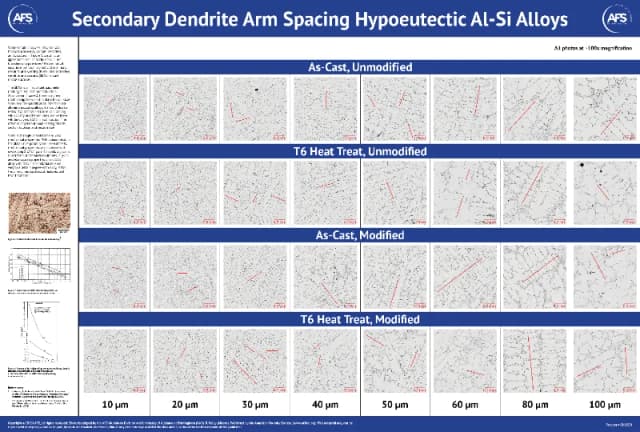
An important microstructural feature of hypoeutectic aluminum-silicon alloys is the secondary dendrite arm spacing (SDAS). Since the SDAS decreases with increased cooling rates, it is often used to estimate the cooling rate in castings. In addition, the SDAS can be used to estimate tensile properties. This new wall chart was developed from the AFS Aluminum Division Technical Committee project where an A356 aluminum-silicon alloy was melted, treated, and poured into an Aluminum Association-certified stepped mold. Two melt compositions were tested, one with grain refiner additions and one without. The solidified casting was sectioned in each step and samples from these sections were prepared metallographically to measure the SDAS. Each step represents a different cooling rate and therefore produces a different SDAS. The chart provides a reference to estimate SDAS from your cast microstructures showing 32 images from 10 um to 100 um in the As-Cast and T6 Heat Treated, unmodified or modified conditions. The chart also shows the relationships between the cooling rate, mechanical properties and the SDAS.
Purchase →
Specific Gravity Test
This standard prepared by the AFS Aluminum & Light Metals Division, documents critical details and best practice procedures for skillfully determining the specific gravity of a reduced pressure testing (RPT) sample. Specific Gravity Testing, in addition to Density Index, is the preferred methodology for evaluating the quality of aluminum melts from RPT samples - having replaced visual comparisons to wall charts. The standard documents a step-by-step guide to equipment design and maintenance, procedural requirements, and detailed instructions for maximizing accuracy and repeatability in determining the specific gravity of an RPT sample. Casting users, students, process engineers, foundry metallurgists, QA lab technicians and other foundry staff and management will benefit from this standard.
Purchase →
Standard Practices for Use of Printed Sand in Casting Production
This standard, prepared by the Additive Manufacturing Division, outlines a series of requirements and best practices to manufacture and acquire printed sand/aggregate molds/cores having consistent and predictable performance. This includes the digital file types used to define the printed components, factors that need to be controlled and documented during the printing process, aggregate qualities, and the printed component properties that need to be monitored. Methods of safely shipping printed components are defined. Methods to safely handle and store printed components at the foundry are also provided. Conditions requiring requalification are highlighted. Those benefiting from the standard include metal casting buyers, printed sand/aggregate service bureaus, metal casting foundries, and experimentalists.
Purchase →